


For years, the story of banking innovation in Canada has been told as a two-player contest. On one side sit the Big Five banks, with their scale, branch networks and deep balance sheets. On the other are digital challengers, promising faster, simpler and cheaper ways to move and manage money.
Credit unions have often been left out of that conversation, cast as steady and community-minded but slow to change, but that framing is about to be tested. Draft regulations for Canada’s Consumer-Driven Banking framework were published in June, and the Real-Time Rail is targeted to launch by the end of this year. Together, they will change who gets access to data, how quickly money moves, and which institutions can compete for Canadians’ business.
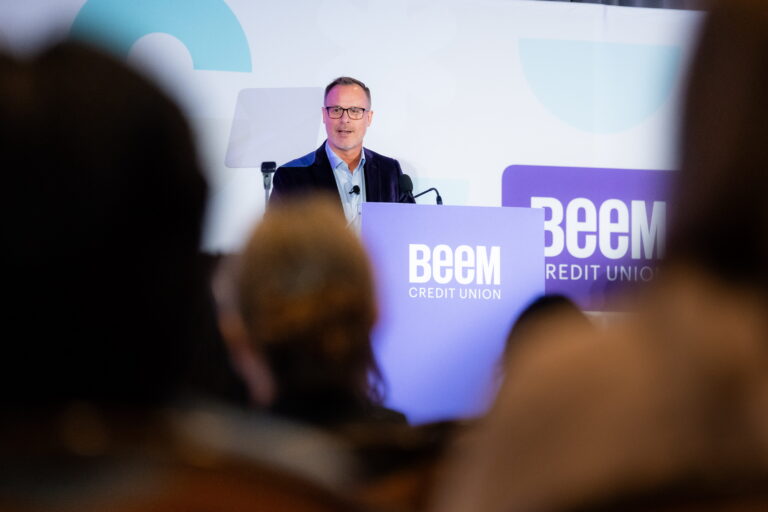
Brian Harris, President and CEO of Beem Credit Union, has seen that shift before. He spent years working in payments in the UK and the Nordics, where open banking is already a reality, before returning to B.C. He argues that credit unions need to serve the members they have today while building for the members they will need next.
The timing is fitting. International Credit Union Day falls on October 15, and this year’s theme, “Cooperative Finance: A Steady Signal in a Noisy World,” asks what member-owned institutions can offer at a moment of economic uncertainty and rapid technological change.
Fintech.ca spoke with Harris about the future of the credit union model, what open banking will actually mean for everyday Canadians, and why he believes incremental change is no longer enough for credit unions.
This year’s International Credit Union Day theme describes co-operative finance as “a steady signal in a noisy world.” Where is the noise coming from right now, and what does a steady signal look like for a credit union?
BH: There’s a lot of noise right now, from geopolitical instability and economic uncertainty to real affordability pressure. We can’t shield our members from that, but we can build a credit union that’s excellent at change: adaptable and resilient, so our members can be too.
The steady signal is simple. We aren’t driven to maximize every dollar of profit the way a publicly traded bank is, so our job is to do what’s in the best interest of the member in front of us. That matters most when everything else feels uncertain.
Younger Canadians expect a very different banking experience than their parents did. How is Beem thinking about serving the next generation of members?
BH: If the next generation isn’t banking with you, that money leaves. Credit unions that define themselves by the members they have today — and don’t think about the members they’ll need in the future — are heading for a cliff. At Beem, we’re constantly balancing the two. A lot of mobile banking is table stakes, but it’s a gateway to doing more.
For first-time homebuyers, for example, our First Home Advantage Program offers a low-interest loan of up to $25,000 toward a down payment, so people who’ve shown good financial habits don’t have to wait years to save. We’re digital-first and people-first, both at once.
What do you think the credit union sector gets wrong about modernization?
BH: The biggest mistake is tinkering around the edges. The credit unions that came together to form Beem were each running on old technology and old processes, and we couldn’t have survived trying to keep those systems afloat. People may love the idea of a credit union, but they often choose providers who offer a better digital experience. If we can’t match their expectations, they go elsewhere.
So we didn’t take the slow, incremental route. We migrated to a single core banking system and launched a new digital banking platform. It wasn’t seamless, but we owed it to members to do the hard stuff now. The real innovation starts from here.
Draft regulations for Canada’s Consumer-Driven Banking framework were released this summer. You’ve worked in markets where open banking is already live. What’s your take on how it will change things?
BH: The draft regulations don’t fundamentally change what open banking enables, but they give us clarity and momentum. Momentum has been Canada’s Achilles heel: lots of talk, not a lot of action. My message is hurry up and get it happening.
No bank likes open banking. Governments impose it to stimulate competition and make clear that your banking data belongs to you. Once a consumer grants permission, any institution, regardless of size, can access it. That lets smaller, entrepreneurial organizations offer solutions that the big banks have little incentive to build. I’m genuinely hopeful that what comes out of open banking becomes a catalyst for real change in Canadian banking.
Who stands to benefit most once open banking is live?
BH: Nobody wakes up and celebrates open banking. What it does is let institutions serve people who’ve been underserved: newcomers, people with gaps or past problems in their credit history, and small businesses. We can lend responsibly without penalizing someone for a short history or a problem they’ve since fixed.
The same goes for housing. If someone has demonstrated good financial habits, why are we making them wait until they’ve saved enough for a down payment? For younger Canadians, open banking also enables tools that show whether they can actually afford something before they take on credit. With how frictionless buy now, pay later has become, that matters. It’s also a real opportunity to help people get on the right footing and use credit more confidently going forward.
Canada has been slower than markets like the UK and Australia to modernize its payments infrastructure. Why does that matter beyond the financial sector?
BH: Payments underpin commerce. On open banking and real-time payments, we’re more than a decade behind those markets. In most markets, the cost per real-time transaction is going down. In Canada, it’s going up. It’s frustrating, but it’s also a huge opportunity if we get it right.
That’s why it matters that institutions outside the Big Five have a voice in how these systems are designed. At Beem, we’ve already upgraded our Interac e-Transfer technology, so we’re ready when the Real-Time Rail arrives.
Looking ahead, what would success look like for you, and for credit unions more broadly?
BH: When I retire, if I could pick one thing I had an impact on, it would be that more people feel confident about their financial future because of what we did at Beem. Everybody deserves someone to help them plan how to get from where they are to where they want to be.
For credit unions, success means more Canadians realizing they have a choice. Most people don’t shop around for their bank, and I’d put that down to apathy more than any fear of switching. Banking hasn’t innovated enough to make change feel worth the effort. That’s where I see the opportunity. Credit unions have a voice, and Canadians have real options.


Leave a Reply