


Investment into Canadian financial technologies approached $1.4 billion during the first half of 2026, a new report from KPMG shows.
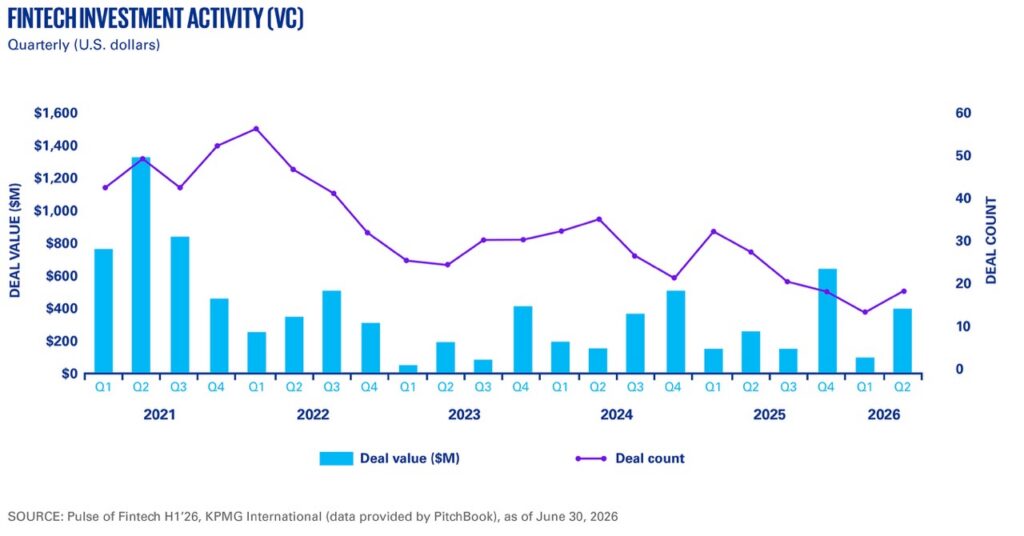
Over the previous six months, US$997 million was invested across 47 deals in Canada versus US$1 billion invested across 56 deals in the second half of 2025, according to data compiled by PitchBook.
The data points to some year-over-year stability, although the figures remain well below 2021 highs.
Dubie Cunningham, a Partner in KPMG Canada’s Banking and Capital Markets practice, observes signals that “Canadian fintech has entered a selective maturation phase.”
This phase sees “investors going after fewer deals but applying more scrutiny to their investments,” according to Cunningham.
“They are being more discerning and going after fintechs that have scale, specialized AI capabilities, and that are competitively positioned to take advantage of upcoming reforms to Canada’s financial services industry,” she says.
Of the US$1B total invested through 2026, over US$600M was invested within the second quarter, across 23 deals, according to KPMG’s Pulse of Fintech H1 2026 report.
A major driver of the second quarter’s rebound was Montreal mortgage innovator Nesto, which in June raised more than $300 million at a $1.5B valuation during a Series F round of financing.
“Canadian fintechs are attracting capital not simply because they are innovative, but because they provide technology, customers, licences, or regulated platforms that can accelerate expansion,” says Cunningham.
AI companies have garnered the most investment among fintechs in 2026, securing 19 deals, followed by crypto in a distant second with eight, and proptech—where Nesto lies—in third.
But “Fintech investors aren’t investing in AI for AI’s sake,” Cunningham believes. “They’re being strategic.”
“Capital is flowing to fintechs that are using AI to solve a specific problem,” she says. “The fintechs that are leveraging AI to make deposit-taking, lending, and payment processing faster and more efficient are creating significant value; those are the types of fintechs where we see investment dollars going over the next year to 18 months.”
“While previous waves of fintech investment rewarded digital access and growth, this current wave is rewarding specialized intelligence and demonstrable economics,” Cunningham commented.
While sector action was concentrated, venture stages were more even; the year has seen 12 early-stage rounds, 11 mergers and acquisitions (such as Robinhood’s acquisition of WonderFi), 10 late-stage rounds, eight seed rounds, and three angel rounds.
Andrew Mathias, a Partner in KPMG’s Deal Advisory practice, sees a “catalyst for fintech investment” in forthcoming changes to Canada’s banking system.
“Consumer-Driven Banking and the Real-Time Rail are opening up the infrastructure that fintechs need to compete, and these regulatory reforms could materially alter fintech economics and create conditions for a new period of competition in financial services,” Mathias posits.
Consumer-driven banking will allow consumers to securely share financial information with fintechs, while the Real-Time Rail will modernize Canada’s payments system.
“Access to secure data-sharing systems and modern payment infrastructure will lower the cost of new services, enable new payment and account-aggregation products, reduce fintech dependence on incumbent institutions, increase partnership and acquisition opportunities, and put pressure on established banks and larger software providers to differentiate,” Mathias remarked.
“We expect the result will be more competition and consolidation for Canadian fintechs over the next year to 18 months,” he stated.
The most recent funding in fintech hails from Helcim, a Calgary-based payment processor serving small and mid-sized businesses across North America, which just closed a $53M Series C round led by BDC Capital’s Growth Venture Fund at a valuation of $250M.
Globally, more than US$100B was invested across over 2,000 fintech deals, Pitchbook data reveals, with more than 50% of that investment going into the US market across over 900 deals.



Leave a Reply